Finding the Main Water Shutoff in an Older Home
Look where the water line enters the house: near the water heater, on a front basement wall, in a crawlspace or by the meter. Test it before you need it.
- Frederick-specific facts
- Steps you can take
- When to call a plumber
The Short Answer
The main water shutoff is almost always where the water line enters the house. In older Frederick homes that means the basement wall facing the street, a utility corner near the water heater, a crawlspace under the kitchen or a closet by the front door. Follow the pipe from the water meter, if it is indoors, to the first valve after it. That valve is the main shutoff.
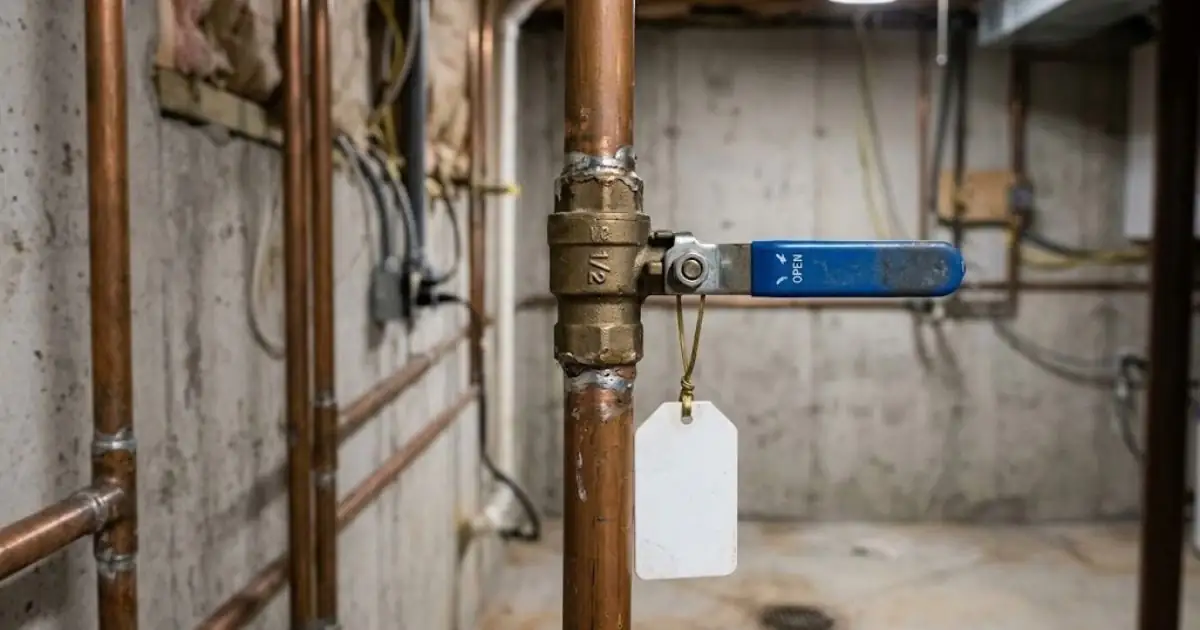
A round wheel handle is a gate valve and a straight lever is a ball valve. Gate valves turn many times and often seize with age, so test yours once a year and replace one that will not close.
Common Shutoff Locations in Older Homes
| Place | Why it is there | What you see |
|---|---|---|
| Front basement wall | Water line comes in from the street. | A pipe through the wall with a valve and often the meter. |
| Near the water heater | Short run from the main. | A valve on the cold supply, which may be a separate heater shutoff. |
| Crawlspace | Slab-on-grade and crawlspace homes. | A valve near the foundation or under the kitchen. |
| Garage or utility room | Additions and newer homes. | A box on the wall with valve and meter. |
| Outdoor meter box | Where the city or town meter sits. | A lidded box near the curb. |
The Meter Valve and the Curb Stop Are Not the Same
At the meter there are usually two valves. One sits before the meter and belongs to the utility. The one after the meter, on the house side, is your main shutoff. Farther back, a curb stop under a small cover near the street also belongs to the utility, and homeowners should not operate it.
The City of Frederick explains that you can turn the water off for plumbing work by using the valve near your water meter, and it provides an after-hours emergency number for service line leaks. In county service areas, the division's emergency line fills the same role. Keep these numbers somewhere you can find them at night.
The customer's responsibility starts at the meter. The utility owns the pipe from the main to the meter, and the customer owns the line from the meter to the house, so leaks beyond the meter are yours to repair.
How to Test Your Main Shutoff Once a Year
Find the valve
Locate it and clear anything stored in front of it.
Close it slowly
Turn clockwise until it stops. Do not force it.
Open a tap
Run a faucet to confirm water stops.
Reopen it
Open the valve and the taps to bleed air.
Tag it
Hang a tag on the valve so anyone can find it in an emergency.
Cannot Find or Close the Shutoff?
Call now. The dispatcher can guide you or send help.
A Valve That Fails Needs Replacing, Not Forcing
Signs the valve is failing
- Handle turns but water keeps flowing.
- Valve leaks around the stem.
- Handle is stuck or breaks off.
- Green corrosion on the body.
What a plumber does
- Shuts water at the meter or curb.
- Replaces the valve with a ball valve.
- Tests the new valve.
- Sets a handle that is easy to turn.
A new ball valve is a short job and one of the best-value upgrades in an older house.
What to Do When a Pipe Bursts and the Valve Will Not Close
Open the lowest faucet in the house to drain what is in the pipes, then call for help right away. A plumber can often shut the water at the meter or the curb stop with the proper key, and burst pipe repair work follows.
If the leak is outside, between the meter and the house, the shutoff at the meter stops it. Water line repair covers the buried pipe, and leak detection service helps when you cannot tell where the water is going.
Older homes in Middletown and the historic neighborhoods of Frederick often have shutoffs that have not turned in decades. Testing one now saves a flood later.
What a Shutoff Valve Replacement Depends On
Why It Matters for Claims
Insurers expect you to stop the water quickly. A working shutoff shows you took reasonable steps.
How Shutoffs Were Placed Before Modern Codes
Houses built before the mid-twentieth century often had a single valve placed wherever the plumber found it convenient. Some sit behind a stair, under a built-in cabinet or inside a floor box. Additions and renovations may have buried the original valve entirely, and later work may have added a second one in a different place.
Modern practice puts a full-port ball valve on the supply as it enters the house, plus a pressure regulator and sometimes a backflow device. If your house has been updated, the layout may follow that pattern. If not, expect to hunt, and write down what you find.
A simple trick helps when you cannot see the pipe. Run a faucet and listen along the walls and floor for the sound of water. The pipe entering the house is where the sound starts, and the shutoff should be near it.
A Ten-Minute Walk-Through to Locate Every Shutoff
- Find the water meter inside or outside and note the valve on the house side.
- Check the water heater and note its cold-water shutoff.
- Look under every sink and behind every toilet for the small local stops.
- Find the outdoor spigot shutoffs, which are often in the basement ceiling.
- Write the locations on a card and tape it inside a utility cabinet.
A household where every adult knows these locations loses far less water in an emergency.
What Modern Code Expects of a Main Shutoff
The International Plumbing Code (IPC) calls for an accessible shutoff valve on the water service entering a building. Older houses predate that rule, so an accessible, working valve is often an upgrade worth making when a plumber is already on site.
Shutoff Questions From Frederick Homeowners
In winter, yes, and drain the lines if the house is unheated.
No. It is the utility's valve. Use the valve at the house or meter.
A plumber can add an accessible shutoff when the wall is open for other work.
Yes. Local stops let you isolate a toilet or sink without shutting the whole house.
Yes. The line is open 24/7.
A waterproof tag with the word WATER and an arrow works well.