Tankless Water Heater Descaling in Moderately Hard Water
Flush a tankless heater once a year in water like Frederick's, which averages about 100 mg/L of hardness. Skipping it shortens the heater's life and can void the warranty.
- Frederick-specific facts
- Steps you can take
- When to call a plumber
The Short Answer
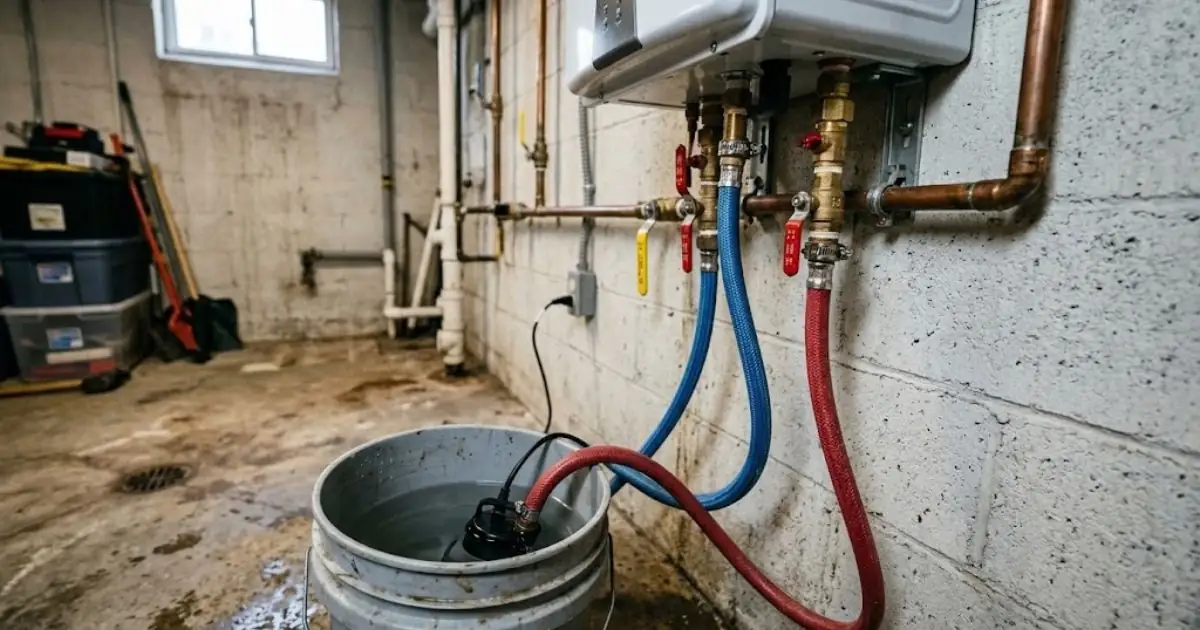
A tankless water heater should be descaled at least once a year in moderately hard water. The process circulates a descaling solution, usually vinegar or a made-for-purpose acid, through the heat exchanger for forty-five to sixty minutes, then rinses the unit with clean water. It removes the mineral scale that forms every time the heater runs.
Frederick city water averages around 100 mg/L, or six grains per gallon. A tankless heater has no big tank to settle scale, so it coats the heat exchanger directly. Homes on hard well water may need a flush twice a year or a softener ahead of the unit.
How a Professional Descale Works
Shut down and isolate
Power or gas is turned off and the water valves around the heater are closed.
Connect the pump
Hoses attach to the service valves and run to a bucket with solution and a small pump.
Circulate
Solution runs through the heat exchanger for the time the maker recommends.
Flush and clean
The unit is rinsed, the inlet filter is cleaned and the valves are reopened.
Test
The heater is fired and checked for temperature, flow and error codes.
What Frederick Conditions Mean for a Tankless Unit
Frederick water is slightly hard, which is mild but cumulative. Over a year, scale thickens on the heat exchanger and narrows the tiny channels, forcing the burner to work harder. A unit with an error code for low flow or overheating may simply be coated.
Gas supply matters as much as water quality. Washington Gas serves many Frederick County homes, and a tankless unit can draw several times the gas of a tank heater at full firing. A line sized for a tank may starve a tankless unit, so a lukewarm shower is sometimes a gas problem and not a scale one.
Owners in Urbana, where many homes use newer high-efficiency units, should check the condensate drain and neutralizer too. Both clog and cause shutdowns that look like heater failure.
Signs a Tankless Heater Needs Descaling
| Symptom | Possible cause | Scale involved? | First step |
|---|---|---|---|
| Water goes lukewarm during use | Scale on the heat exchanger. | Often. | Descale and clean the inlet filter. |
| Error code for overheating or flow | Scale restricting water flow. | Often. | Read the code, descale. |
| Rumbling noise | Scale and trapped air. | Often. | Flush and purge. |
| Fluctuating temperature | Flow sensor fouling or low gas. | Sometimes. | Check sensors and gas. |
| Unit will not fire | Ignition fault or vent block. | Rarely. | Inspect venting and ignition. |
Tankless Heater Acting Up?
Call and share the model and the error code.
What an Owner Can Do and What to Leave to a Technician
An owner can usually
- Clean the cold water inlet filter.
- Check the vent outdoors for blockage.
- Note the error code and the date.
- Order isolation valves if none exist.
A technician should
- Descale with a circulation pump.
- Test gas pressure and combustion.
- Replace sensors and the heat exchanger.
- Correct venting problems.
Without service valves, a flush cannot be done. Adding them is the first job, and it makes every later visit simpler.
Slowing Scale Down Between Flushes
A water softener ahead of the tankless unit is the most effective protection, and it benefits every other appliance as well. See water softener installation if scale is a recurring problem.
Some owners also set the water temperature no higher than needed. Scale forms faster at higher temperatures, so 120 degrees instead of 140 slows the buildup and also reduces scald risk.
If the unit is more than twelve years old and has been neglected, a flush may not restore it. Tankless service explains what a technician checks, and replacement is covered if repair is not worth it.
A Simple Yearly Tankless Routine
- Mark a date on the calendar each fall for the flush.
- Keep isolation valves accessible and labeled.
- Clean the inlet filter every few months.
- Check the condensate drain on a condensing unit.
- Keep a record of each service for the warranty.
What Descaling Costs Depend On
Warranty Records
Keep each flush invoice. Makers may ask for proof of maintenance if the heat exchanger fails.
What a Scaled Heat Exchanger Costs You
Scale is a poor conductor of heat. A thin layer on the heat exchanger forces the burner to fire longer to deliver the same temperature, which raises gas use and wears the parts. The narrowing channels also cut flow, so the unit may need a higher water temperature setting to produce comfortable hot water.
Left alone, scale causes shutdowns. Sensors read an overheated exchanger or too little flow and stop the burner as a protection. Repeated shutdowns damage the heat exchanger itself, and that is the most expensive part of a tankless unit. A flush costs a small fraction of an exchanger.
Warranties reflect this. Many makers will not cover a failure caused by scale, and they may ask for proof of annual service. A record from a licensed plumber is the best defense.
A Quarterly Look That Takes Five Minutes
Look at the display
Note any codes and the set temperature.
Check the filter
Clean the cold water inlet screen if it is dirty.
Check the vent
Make sure outdoor terminations are clear of leaves and snow.
Feel the pipes
A sudden loss in hot water volume may be an early sign of scale.
Standards That Cover Tankless Installations
A gas tankless unit falls under the International Fuel Gas Code for its gas supply and venting, and its water connections follow the International Plumbing Code (IPC). Inspectors check both when a unit is installed or replaced.
Tankless Questions From Frederick Homeowners
Yes. Many makers approve white vinegar, but check your manual for the amount and time.
Once a year in moderately hard water, more often in hard water.
A plumber can install them, which makes flushing possible.
No. Gas supply, flow minimums and sensors can also cause it.
Yes, for leaks and safety problems. The line is open 24/7.
Often around twenty years with care.